Showing posts with label URBANISM. Show all posts

Thursday, October 2, 2014

Helipads on top of High rises in India - is there a rationale?

by Sujith.G.S

I was reading through the article regarding the Los Angeles' Mayor's announcement saying that for new buildings it wasn't mandatory to have helipads on top as per fire rescue guidelines, as they limit the city's skyline to flat topped boxes and wondered about the relevance of this rule in an Indian context. The intention behind the Mayor's move was to have a more interesting skyline for Los Angeles, giving architects the freedom to go beyond flat-tops.


Image courtesy  - www.dailynews.com

los-angeles-no-longer-requires-helipads-on-buildings-allowing-for-bolder-skyscraper-designs


The logic behind this particular guideline, which is mandatory as per the National Building Code for buildings above 60m in height, is to have an escape mechanism for helicopter evacuation in case of fires in high-rise buildings. Although altruistic in intention, the practicality of landing a helicopter on top of a burning building needs to be analysed, with several experts felling that this is extremely dangerous. What is interesting is that Los Angeles was one of the few remaining cities in the US were this rule existed. Alternate mechanisms like separate elevators for firefighters, additional staircases etc. could be more effective and practical. 

In an Indian context, as was seen during the recent fire in Mumbai, helicopter evacuation was sought as a last resort to evacuate the trapped firemen. There also, the helicopter did not touch down on top of the building but only lowered the Navy sailor to rescue the trapped firemen. This does lead to question whether such a tactic can be employed instead of having a full fledged helipad on top. There have been plenty of instances where the DGCA has refused permission to land a helicopter on top of these helipads citing safety concerns. If the helipads are seen unsafe by the aviation authorities then why bother having them in the first place?

Image courtesy - www.indiatimes.com

More than any aesthetic consideration, one needs to wonder whether spending such a lot of extra money for the structural design and reinforcement required for erecting a helipad on top of a high-rise building is worth the expenditure if it is not going to be of much practical value. This is especially relevant in high-rise residential developments where this cost accrued to the builder is directly transferred to the resident. We need rules and regulations which work, which are practical and which takes into consideration all the stakeholders and not merely rules which exist on paper for a feel good factor. We must also understand that the value of a life is paramount and should not be compromised at all. It is high time that we rationalize the regulations and take into confidence the building community so that they do not cut corners and come up with inventive solutions to work around ineffective rules. It is thus critical that we revisit these regulations and reframe rules which are really effective and relevant in today’s context. Parallelly, we need to strengthen and better equip our fire services to deal effectively with emergencies in high-rises. The Los Angeles announcement has come at just the right time for us to introspect on our situation and address the existing concerns.


Wednesday, February 8, 2012

Kala Ghoda arts festival, Mumbai 2012

The 2012 Kala Ghoda Festival is currently going on in Mumbai and is one of the most exciting street festivals in India. It essentialy acts as an interface between art, architecture and the public realm, inviting & providing an opportunity for the common public to interact with art and artists, making art accessible for the lay person. It also serves the function of enlightening the common man on the issues facing us & our societies. Apart from the street exhibitions of paintings and sculptures, there  are plenty of installations on various themes like the over-dependance of man on technology, unbridled pollution of our natural resources like our seas and beaches, excessive intrusion of the social media into our lives etc. There are screenings of various films & documentaries throughout the period of the festival, along with concerts and music shows. The historic buildings of the David Sasoon Library & the Jehangir Art Gallery provides an ideal setting for the plaza, an urban environment with a compact urban fabric enclosing space which serves as an ideal gathering space. The ever increasing crowds witnessed this year is a testimony to the popularity & success of this exciting festival.


Wednesday, December 21, 2011

GATED COMMUNITIES, DEAD SOCIETIES

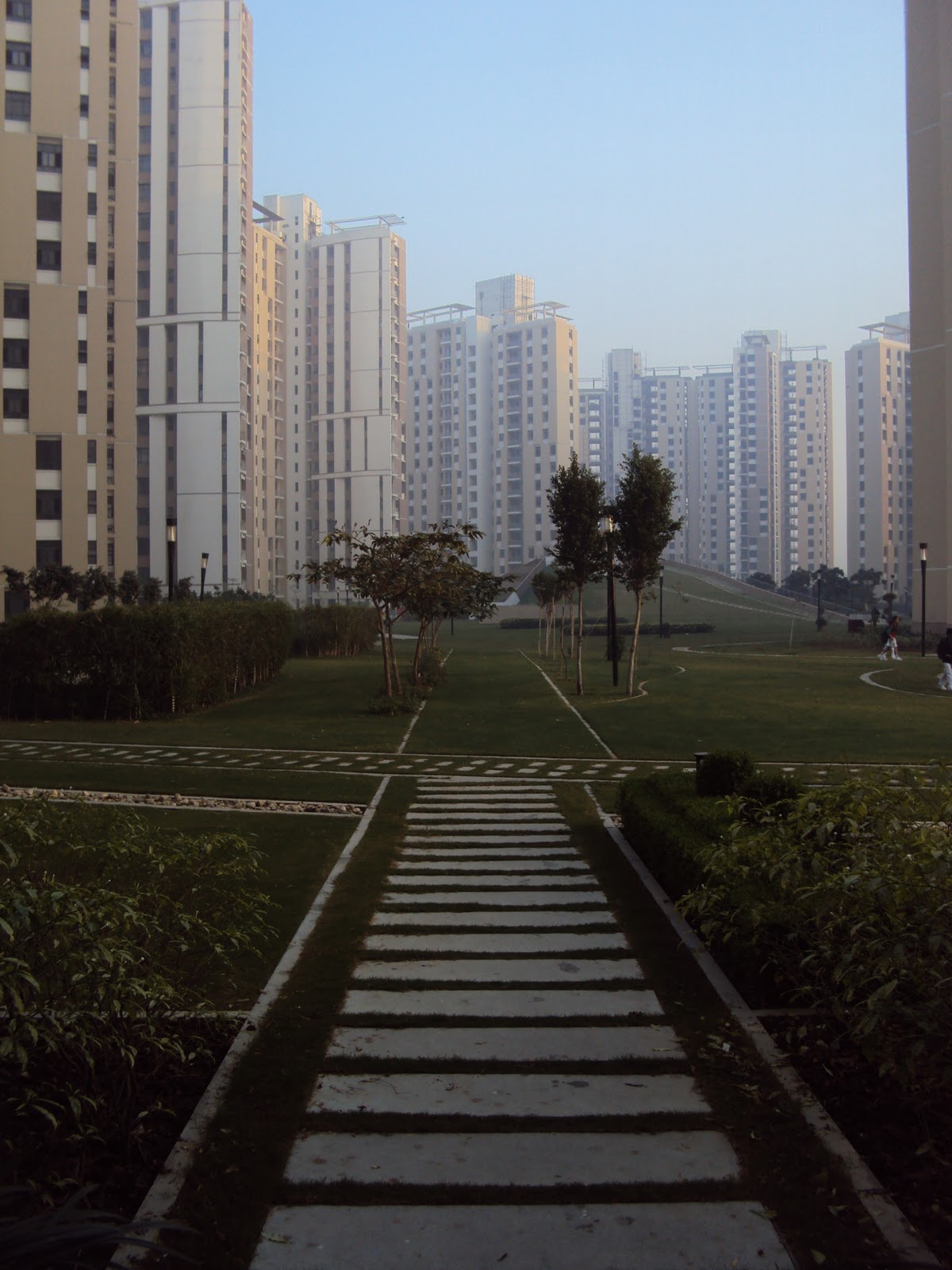
On a recent visit to one of the innumerable gated communities that have sprouted all around Noida & Greater Noida, I had a chance to experience firsthand both the pros and cons of these new building typologies. A lot of debate is happening whether these communities are beneficial to society, whether they increase the gentrification & fragmentation in our societies. I must say that I had been bowled over by the sheer scale of the development & the amount of investment required to develop such massive facilities. The said project consisted of a group of 15 to 20 apartment towers, all averaging 20 floors in height, which are organised around a huge central open landscaped area. The built spaces are pretty typical of the present concept of apartment block - tall towers with 3 apartments per floor. Nothing unique about the vocabulary or spatial planning.
The central space is a huge lawn with hard & soft landscaping done to create a comfortable serene ambience. The scale of this space is massive, being surrounded on all sides by tall apartment towers like sentries standing guard. There is a lot of planned vegetation, bamboos, palms and shrubs, creating a beautiful natural space. Towards the centre of this space, the land gradually rises to form a small artificial hillock. There are pergola covered platforms on the top. Below this artificial hillock are the common areas, the billiards rooms, the common gym, the lounge, the recreation hall etc. In front of this space on the lower level is a quaint little swimming pool, complete with wooden decking and reclining chairs and surrounded by vegetation. Yet, there is no privacy here, surrounded as it is by tall built blocks all around.


The advantages to the occupants of such communities are many. A 24hr dedicated facilities management team takes care of the maintenance of all the common spaces. The landscaping and lawns are properly maintained & clean. The security is taken very seriously. All vehicles are screened at the entry, vehicle number & time of entry noted. There are guards everywhere, from the entrance lobbies of the individual towers to the common gym & swimming areas. There is an underground parking in addition to the surface parking. There is 24hr electricity & water supply with a generator backup. The recreation needs are taken care of inside the gates itself. One only needs to splurge money to be able to afford to own a unit inside. Of course, all these maintenance facilities come at a price, a compulsory monthly amount in addition to annual subscriptions. But the customer is happy. He is free of responsibility. Today, people are willing to let their purse strings loose as long as they don’t have to be bothered with the mundane chores.
One of the things that stuck me was how our concept of a social space has changed completely in these gated communities. Here, the underlying & overlying sentiment is the need for privacy, the need to keep social interactions to a minimum, a need to be nameless, a need to be aloof. I could not but wonder how much it is a contrast with our traditional notions of space and community, the vibrant fabric which has held us together for ages. In a span of a few decades, our rich social fabric is being rapidly replaced by an unfamiliar concept of anonymity. It is just like the debate over the virtues of foreign multibrand retailers versus the neighbourhood kirana stores. There, again, the question is that of anonymity versus social face to face interaction.
The huge expanse of the lawn in the centre of the built towers offers a veiled sense of anonymity. People in their track suits walk briskly past each other, often even without glancing, with earphones plugged into their ears. Or in the rare case, a brief glance and a nod. There is no pause in the gait, no time to talk. Only the senior citizens bother to interact with each other, nostalgic of a time when social notions were completely different. 


It is pretty amazing that other than the central lawn and the common playing rooms, there are absolutely no spaces even for a pause, let alone for interaction. In the ground level of each tower is a bland entrance foyer with a uniformed guard, which leads to the lift lobby, a space with no natural light or ventilation and one which is cramped, undoubtedly to reduce the common area to cut down on the cost for the builder. The same is the case for the other floors as well. One enters into a narrow corridor, which leads in different directions to the different apartments. No space to pause, no space to meet or talk.
The individual apartments however, are spacious, even well lit and ventilated. There are balconies which lead out from the living room as well as from the dining. The bedrooms are spacious and well finished and so also the bathrooms. Yet, because of the stand alone nature of the towers, each apartment is an isolated entity, a vertical mass without any connections. You don’t have neighbours; you don’t even have balconies which offer scope for any interaction. Your only source of interactions is the ‘social networks’, the virtual world with online friends, game request and what not, far removed from the immediate physical reality. But then, that is what today’s generation want - virtual interactions as a substitute for physical interactions. Our norms of relations are changing; our patterns of behaviour are changing. Children are most affected. They become unable to interact effectively with the outside world. But no one seems to mind, especially the parents who need to ne genuinely concerned.  Thus, it is only natural for the builders to develop spaces which cater specifically to this new reality and, in the process, make a handsome profit. The impact of these built masses on our society and sociological patterns do not seem to be the concern of either the developer or the architect who has designed the space – money and only money matters.
The main criticism of such gated communities is that they are exclusive, that they create further divisions in an already divided society. One only needs to visit one of these places to realise that there is a lot of truth in that argument. These spaces are exclusive zones, islands in our social fabric. There is no give and take with the surrounding communities and people, no dialogue, no interaction whatsoever. That is their USP which brings all the rich clients to buy apartments in these communities. But from a social & spatial point of view, there are a lot of undesirable issues which arise. The sense of community is lost, outside the gates usually the areas become deserted, roads become less frequently used by pedestrians, there are no neighbourhood markets or shops as all the inhabitants prefer to shop in supermarkets and malls. People go out of the gates in cars only. Foot travel is rare. The result of all this is that most often, the surrounding area becomes unsafe and deserted, especially after dark. Cases of theft & waylaying of people are common. Urban character and quality is lost.
Class boundaries are further accentuated and formalised. Inequalities become glaringly obvious. There are often complaints of cornering of services like water and electricity. The people outside become more resentful and suspicious. Our societies lose their cohesiveness and character. Yet, with more and more such communities being developed and with demand increasing from an ever affluent middle class, the phenomenon of gated communities is here to stay. Only time will tell how our society and spaces will evolve positively or negatively reacting with the gated communities.

Thursday, October 13, 2011

GATED COMMUNITIES & URBAN GENTRIFICATION

With the opening up of the Indian economy in the 1990s and the neo-liberal economic policies followed thereafter, India has witnessed a steep rise in the fortunes of its middle class. There is increased purchasing power resulting in the middle class being more demanding & vocal. The outlook of the middleclass has changed from one of conservatism & savings to one of aggressiveness and splurging.
One of the direct results of this is that the outlook of the better-off sections of society has changed. They are no longer able to tolerate the realities of the other half, the less privileged half. The progress of technology, rise of the service sector and the changing values have made them less tolerant to sufferings and hardships of life. They want to be insulated from it, becoming more and more enmeshed in a virtual world, addicted to technology and social networks.
The effects of this are reflected in architecture & urbanism too. One of the direct outcomes of this is the rise of ‘Gated Communities’ in most of the larger cities. These are self enclosed spaces, literally separated from the rest of the neighbourhood with high walls and extra security, where along with residential spaces (read apartments) are present all kinds of other amenities like shopping spaces, recreational spaces, swimming pools, healthcare facilities, even kindergarten and schools. There is 24 hour power & water supply with backup present. An army of maids, drivers and service people take care of the maintenance needs of the residents. The result of such spaces is that the inhabitants hardly step outside the gated walls other than for work. They live a life segregated from the rest of the neighbourhood, cut off from them. They do not have to face any of the normal issues and practicalities of living in a city.
One cannot deny that there aren’t many advantages to this concept for the inhabitants. The urban dwellers prefer this sort of communities due to their increased stress on security, the comforts that they provide, the 24hour maintenance and service that are offered. These become important for the middle class family as in most cases, both the parents will be working. The hectic work schedules will leave little time to be bothered by additional responsibilities of running a family and home. So, a lot of them take the easier way out, splurging money so that others will take care of these mundane responsibilities.
A lot of people who come from other cities often are attracted to these communities, as their hardships in coping with an alien city and language are somewhat reduced in these anonymous communities. This along with the fact that there will be people all around of similar background and class provides a certain element of security. For the individual working women too these communities provide a sense of security. Also, most of these communities have societies which take care of the running of the communities. The societies often arrange get togethers where the families can come together for a Sunday getogether or for a fun filled evening. Yet, other than these, the actual interactions among the residents are often very little, and in a lot of cases, the people wouldn’t know even the names of the family living in the next apartment. Yet, people prefer this false sense of community and anonymity. Lifes' are being compartmentalised. Rigidity is becoming the norm.
This aloofness is resulting in the perhaps unknowing creation of gentrification in societies. The communities are literally cut off from the rest of the society surrounding them. They are individual pockets in the urban grain, standing alone. They live in an aloof almost separate world, without having to be exposed to the challenges and cruelties of life.  This often leads to the increase in the class divisions present in society, the inequalities are further aggravated. The impact of this on the thought process and outlook of the people are often subconscious, but very real. Thought processes become rigid, plurality is lost and often empathy is totally unknown, leading to further gentrification of society.
One of the overlooked impacts this has is on the growth and development of children. The kids who grow up in such spaces lead a much protected life, almost in a cocoon. They are shielded away from normal interactions with people from different backgrounds, not exposed to the sights, smells, sounds and narratives of the rest of the society. Often, their major exposure to the outside world is through the television and internet, where the make believe world portrayed is taken by the children to represent real life.  In growing up in such a context, they often are unprepared to face the challenges that life throws up at them, often at a loss even to interact with other sections and accept divergent viewpoints.
Also, these gated communities create unrest and resentment in the people living outside due to the inequalties. The open spaces and parks for children in urban areas may only be found inside these communities, which is inaccessible for the outside people. In some cases, the promoters and developers of such gated communities arm twist public administration officials and even bribe them to getting water connections and power lines. This, while the surrounding areas may not be fortunate enough to have even such facilities, creates feelings of injustice and resentment among the outside people.
Another unwanted offshoot of the gated community phenomenon is that there are different types of gated communities present in urban areas depending upon the earning power and class of people. Right from the ultra high class societies to the average middle class to the wannabes or pretenders... There are gated communities to cater to all the different sections. The net result is that our societies are being more and more fragmented into separate pockets, separate groups, mutually insulated from one another and the rest of the surroundings. One can only view with increasing trepidation this class mentality and stratification. Soon, the days of altercations between different gated communities for resources like power and water supply may not be far off...

AGENDA 21 - BARCELONA'S COMMITMENT TOWARDS SUSTAINABILITY


The expression "Agenda 21" was coined at the Earth Summit (Rio de Janeiro, 1992) to refer to the plan of action that states would have to implement in order to transform the current model for development, based on the exploitation of natural resources as if they were unlimited and unequal access to the benefits of those resources, to a new model for development capable of covering the needs of present generations without compromising the capacity of future generations. This is what is known as sustainable development, i.e. development that is durable, efficient and rational in the use of resources and equitable in the distribution of benefits.

The final document produced by the United Nations ten years ago contained a chapter (Chapter 28) dedicated to the role of cities in this ambitious resolution for change. It recognises both the responsibility of cities and their capacity for transformation. As has been observed on occasions, seldom have a few brief lines of a formal declaration provoked such an enthusiastic reaction. At present, over 5,000 cities around the world are drawing up their own Local Agenda 21s through mechanisms involving participation by the local community, with the objective of establishing shared objectives and milestones to contribute locally to the sustainable development of our planet's society. Local Agenda 21s are a good example of the old ecologist maxim "think globally and act locally".

Barcelona is one of the cities taking part in this movement and it is now completing its Agenda 21. This article aims to outline the characteristics of this complex and exciting process. Barcelona's status as a large city in the context of Europe undoubtedly makes this an experience worth studying and sharing.
The sustainable Barcelona of the 21st century has to be a place where solutions are found.
These socio-economic, environmental and urban planning-based solutions will preserve and improve the quality and quantity of recreational spaces for the community, ‘people spaces’ – street and squares, parks and gardens and with plenty of green spaces & people friendly architecture. Solutions so that the mixed, compact city that we so desire does not become overcrowded & suffocating. Ways of recovering and re-shaping the urban fabric, emphasising creative rehabilitation and always looking towards the future. Solutions that provide new mobility based on public transport that is equally accessible for al, regardless of destination, with moderate environment costs. Solutions that result in healthier people and a healthier environment, free of waste, with less noise, with breathable air and that is decent for other living beings that share the same space with us. Solutions, therefore, that integrate selective collection practices and waste recovery and recycling; that put a premium on fresh and healthy food; that save water, energy and resources; that minimise the city’s negative impact on the planet and the atmosphere. Solutions, finally and above all, that foster positive social integration and the social well being of people, wherever they may come from”.
In 1995, Barcelona's Town Council resolved, with the unanimous vote in favour of all political groups represented, to become a signatory of the Aalbörg Charter. This Charter was the local response to the challenge issued by the United Nations and it was a harbinger of the widespread local movement that would arise in Europe for promotion of Local Agenda 21s. In contrast with the nature of some international declarations, it was an innovative manifesto set out in an attractive style with clearly expressed aims. It was based on the recognition of the responsibility of cities, particularly in the western world, for the current situation (owing to demographic concentration, consumption of goods, services and land, transportation, energy consumption, etc.) and the observation of the capacity of cities to contribute to sustainable development from a privileged position for fostering participation, agreement and mobilisation of forces and resources.

Agenda 21 is neither a closed process nor an exercise in exact sciences: each city must select its own approach to drafting its Agenda 21, depending on its characteristics and circumstances.
In 1998 and 1999 thirteen thematic working groups were formed with different members of the Council to carry out, on a basis of consensus, a diagnosis of each area, formulating proposals for future action and, in some cases, suggesting indicators for monitoring. In 2000, the Council adopted these documents as "Materials for Debate" and resolved to undertake a phase of citizen participation and debate, through which the Council's work will be opened to other organisations and players and citizens as a whole. This is an extremely important decision for the process, owing to its ambitious nature. When the process is completed, the Council will be the body with the capacity to decide on the approval of the final content.

[ ]
The Participation Process
The extension of the debate to include citizens seemed indispensable if the process was to be successful. Making an Agenda 21 with the greatest possible degree of participation not only legitimates it, but above all it allows a larger number of people to assimilate its importance and assume its objectives. At the same time, however, obvious difficulties arise, such as the size of the city, the lack of citizen awareness of the process and the complexity of the issues and the relatively limited time available.

The main challenge, obviously, was how to attain a sufficient degree of citizen involvement, taking into account that the move from the core of highly informed and concerned individuals to all citizens could not be made in a single step. It therefore seemed appropriate to focus efforts on fostering the participation of citizen organisations and groups and to leave the door open to intervention by individuals. This decision implied adoption of a participatory approach that ensured that all views were represented, while prioritising quality over quantity.

The framework document's proposal for development of the participation process can be summed up in the following elements:
·         three phases: information, deliberation and decision
·         two approaches to work: regional and thematic
·         two types of involvement: organisations and citizens


The 10 Objectives
1.   Protect open spaces and biodiversity, and expand green belts.
2.   Defend a compact, diverse city, with quality public space.
3.   Improve mobility and make streets an attractive place.
4.   Attain optimum levels of environmental quality and become a healthy
city.
5.   Conserve natural resources and promote the use of renewable
resources.
6.   Reduce waste generation and foster a culture of re-use and recycling.
7.   Augment social cohesion, strengthening mechanisms for fairness and participation.
8.   Promote economic activity oriented towards sustainable development.
9.   Advance the culture of sustainability through environmental communi- cation and education.
10.   Reduce the city's impact on the planet and promote international co- operation.

All details obtained from the website  –

Monday, October 3, 2011

'CITY IS GOING TO VILLAGE' - A horrendous hypothesis masquerading as a socially equitable solution

Dear Mr.Gautam Bhatia,
Your article in the Sunday Times of India, dated 2/10/11, looked like one against the unorganised growth and the pathetic state of affairs of our present day cities in India. Your dissection of the anomalies at the heart of the modern city, the lack of infrastructure, the lack of sanitation, the ‘daily wars for water, space in schools & roads’...they all paint a true picture of the ground realities in our cities.
Your analysis on the huge influx of migrants into the cities and the resultant impact on cities being relegated to ‘a modern day trading outpost’ is spot on. As you say, there are no innovative solutions yet as to how to integrate this urban migration into the fabric of our cities. True, there are administrative failures, a ‘lack of will to investigate new solutions. This attitude has left Indian cities imprisoned behind the stranglehold of conventional planning’. These are indeed the present state of affairs in our urban areas, further burdened by the demand and expectations of an ever growing affluent consumerist middle class.
Now, what is the solution to this? How do we overcome this state of affairs? How can we reclaim back our lost space? It is indeed worth examining if there are alternate solutions which can be implemented.
So far, the analysis of causes and ground realities stated are right on in the article. But now comes the confusing part, and I quote: “Today, the need to accommodate the rising numbers is extending the city into multiple corridors between the metros; a new way to include the many villages and small towns along the path. It is the government’s way of taking the city to the village.
Cities designed explicitly for the rural areas is not just a good idea for the poor, but can act as a game changer for the self centered ugliness created in the metros by the middle class”.
Mr.Bhatia, this hypothesis of yours, of taking the cities to the villages is pretty absurd. How will unleashing the unbridled forces of real estate development onto a village landscape help in the betterment of the villages, which in turn will help in reducing migration to the existing cities? It will be architectural & urban genocide. How will developing cities on agricultural land bring about a better state of affairs? How will this bring about a better life for the city dweller or for the farmer?
If you are assuming that merely by creating a city like environment will benefit the villagers, that it will make their lives better, that it will stop them from migrating to cities, then your stand is pretty weak. By exporting a city and its infrastructure into a rural setting, you would be doing more harm than good. In the name of creating infrastructure & liveable spaces, developers & other market players will take over agricultural land (and I assume that they will get land at cheaper rates due to the fact that they are doing a great ‘service’ to the villages), rape it and start erecting multi-storeyed apartments & luxury villas, which would then be marketed & sold at exorbitant prices, as they are set in a ‘pristine unpolluted rural environment’. Do you for one moment, Mr.Bhatia, think that the villagers, the original inhabitants of that place will get possession of such habitats? Will they be able to afford it? How will their social structure & support systems function in this new environment? How will their ways of life be accommodated? What will be the impact on their thoughts, their lives, their families? How will they cope when the cash doled out to them for their land is splurged on drinking by the men and finished? Where will the women and children go?
What will be the impact on the loss of livelihood be on the villagers? How will they be employed? How will agriculture & food production be affected? It will only be logical to assume that in such a scenario, more and more people will turn away from agriculture – they will find alternate employment in the ‘new city’. How will that contribute to the food shortage and malnutrition plaguing the country?
By turning our villages into miniature cities, we would be encouraging the use of more automobiles, more pollution, more eating up of resources – opening the door to all the problems found in our cities today. And my dear Mr.Bhatia, who will pay for all this development? Who will bear the cost of this Utopian proposal?....the government? The government & our public administration is so ineffective that they are unable to properly implement the existing rural welfare, education, health & social welfare schemes, which if properly implemented would have made the village a much better place to live in....So then it would have to be the private sector? As we all know, the private sector is attracted only if there is a great return on investment, lured only by the smell of profits. This then would simply end up as creating cities based upon the same template which would have been used in our present cities to create this present mess. And we would end up destroying our villages and agriculture lands to create the same pattern of monstrous urbanism.
Mr.Bhatia, this hypothesis of yours is simply playing into the hands of developers and real estate players, who have currently almost exhausted the development potential in our present cities and are now turning their greedy eyes onto the villages, so that they can make quick profits in the guise of altruistic motives. It is just like a noble sounding excuse used to fool the common man, to appeal to the moral conscience of the middle class. This article is reflective of the propaganda machine that the corporate media in India is turning into. A lot more was expected from such a senior architect & writer. It would not be asking too much, from someone like you Mr.Bhatia, to properly analyse & think through your hypothesis dispassionately, to evaluate the impact of ideas before proposing them, that too in a national daily. Or it would seem that the propaganda machine has already spread its net far and wide.

Friday, September 30, 2011

NO COMMENTS!!!

YOU REALISE THAT DELHI IS ONE OF THE WORST CITIES WITH REGARD TO PARKING SPACE WHEN YOU SEE THESE.........I guess civic sense takes a backseat when one is faced with a lack of infrastructure...